
White Friday (also known as Blessed Friday) lands on Friday, November 27, 2026, with Cyber Monday on November 30. The deals are already flooding inboxes, and so are the scams built to look exactly like them. Fake stores, “missed delivery” texts and too-good-to-be-true social ads all peak in the same few days, because that’s when people buy fast and check less.
This guide covers the seven tricks you’re most likely to run into this week, how to spot each one in a few seconds, and exactly where to report them if you’re in the US or the UK.
How big is the problem?
In the UK, police data shows shoppers lost £11.8 million to online shopping fraud between November 2024 and January 2025, according to figures from Action Fraud reported by Which?. In the US, the Federal Trade Commission’s April 2025 data spotlight ranked fake package delivery problems as the most reported text scam of 2024, with most of those messages pretending to come from USPS.
Those are only the cases people reported. The real number is higher.
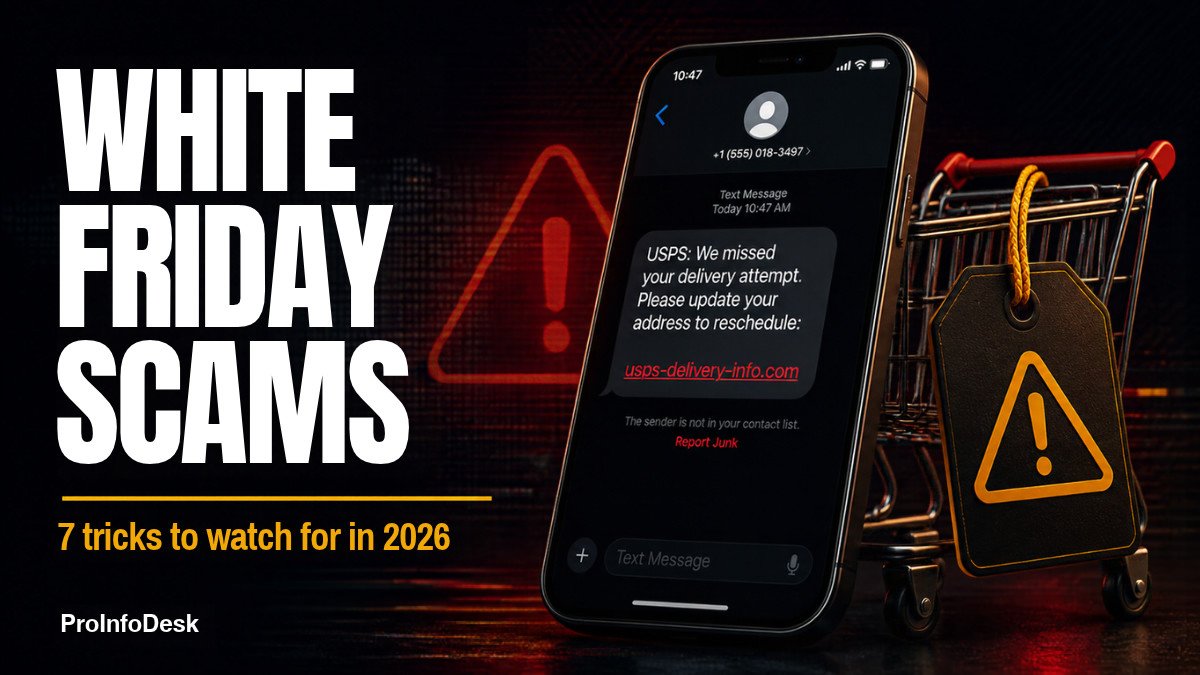
1. Fake “missed delivery” texts
This is the one you’ve probably already received: a text saying a parcel couldn’t be delivered, your address needs confirming, or there’s a small fee (often around $1 or £1.50) to rebook. The link leads to a page that steals your card details.
How to spot it:
- USPS does not text you about a delivery unless you signed up for text tracking yourself, and even then the message won’t ask for payment or personal details.
- Royal Mail, Evri, DPD and other UK couriers may text genuine updates, but a real one won’t ask you to pay through a link in a text you weren’t expecting.
- The link uses an odd web address rather than the courier’s real site.
What to do instead: open the courier’s app or type its website address yourself, then paste the tracking number from your order confirmation.
2. Fake online stores
Scam shops copy the look of real brands, or invent a “store closing” sale with huge discounts on trainers, gadgets or designer goods. You pay, and either nothing arrives or you get a cheap knock-off.
Red flags:
- A web address that’s slightly off (extra words, odd endings, misspellings).
- Discounts of 70–90% on items that are rarely discounted at all.
- No real contact details, no returns policy, or terms copied from another site.
- Payment only by bank transfer, gift card or crypto.
Before buying from a shop you’ve never used, search its name with the word “reviews” or “scam” and check how long the site has existed. A store that appeared three weeks ago with a White Friday sale is a bad sign.
3. Social media ads for “deals” that don’t exist
Many fake stores find their customers through ads on Instagram, Facebook and TikTok. Which? warns that scam ads now often use deepfake videos and AI-generated images of well-known brands or celebrities to look convincing.
Tap through to the brand’s verified account or official website and check the deal is really there. If it only exists in the ad, skip it.
4. Phishing emails dressed up as retailer offers
Expect emails that look like Amazon, Walmart, Argos, Currys or your bank, promising a voucher, a “loyalty reward” or a giveaway if you fill in a quick survey. The survey collects your personal and card details. Some victims then get a follow-up call from someone pretending to be their bank’s fraud team.
Never log in through an email link. Go to the app or type the address yourself. If your bank calls, hang up and ring the number on the back of your card.
5. Fake “price drop” discounts
Not every bad deal is a crime, but some sellers inflate the “original” price just before a sale so the discount looks bigger. Searches for price scams spike every November for a reason.
Use a price-history tool (such as CamelCamelCamel for Amazon in the US, or PriceSpy in the UK) to see what an item actually sold for over the past few months before you buy.
6. Gift card and “pay another way” requests
If a seller, a “customer support agent” or a marketplace buyer asks you to pay with gift cards, a wire transfer or crypto, stop. Legitimate shops take card payments, and paying by credit card gives you far stronger protection if something goes wrong (in the UK, Section 75 covers credit-card purchases between £100 and £30,000).
7. Fake customer support numbers
When an order goes wrong, people search for a support number, and scammers buy ads or post fake numbers that look official. The “agent” then asks for remote access to your device, your card details or a one-time code.
Only use contact details from the retailer’s own website or app, and never share a one-time passcode with anyone who calls you.
Quick checklist before you pay
- Did I go to this site myself, or did a text, email or ad send me here?
- Is the web address exactly right?
- Is the price believable compared with other big retailers?
- Am I paying by credit card or a protected method like PayPal?
- Is two-step verification switched on for my email, Amazon and bank accounts?
How to report a scam
In the US
- Scam texts: use your phone’s “Report junk” option, or forward the message to 7726 (SPAM).
- Fake USPS messages: email spam@uspis.gov with a screenshot that shows the sender and date.
- Lost money or shared details: contact your bank or card issuer first, then report at ReportFraud.ftc.gov. You can also file with the FBI at ic3.gov.
In the UK
- Scam texts: forward to 7726.
- Suspicious emails: forward to report@phishing.gov.uk.
- Lost money: call your bank on the number on the back of your card, then report it to Report Fraud at reportfraud.police.uk or on 0300 123 2040. Report Fraud replaced Action Fraud in December 2025 and covers England, Wales and Northern Ireland. In Scotland, call Police Scotland on 101.
Frequently asked questions
When is White Friday 2026?
White Friday is Friday, November 27, 2026. Cyber Monday follows on November 30.
I clicked a link in a scam text but didn’t enter anything. Am I safe?
Usually the risk is low if you didn’t type any details, but close the page, don’t download anything it offers, and keep your phone’s software up to date. If you did enter card details, call your bank straight away and ask them to block the card.
Are White Friday deals on social media ever real?
Yes, brands do advertise real deals there. The safe habit is to never buy through the ad itself: find the brand’s official site or app and check the offer exists there.
Is paying with a debit card safe?
It’s safer than bank transfer or gift cards, but credit cards and services like PayPal usually give stronger refund protection if a seller turns out to be fake.
The bottom line
Most White Friday scams rely on one thing: getting you to act before you think. Slow down, go to retailers directly instead of through links, pay by card, and report anything suspicious. It takes thirty seconds and helps stop the same scam reaching someone else.
Related on ProInfoDesk: Is Temu legit? Prices, delivery and risks · Outlook zero-day patched: update Office, not just Windows