
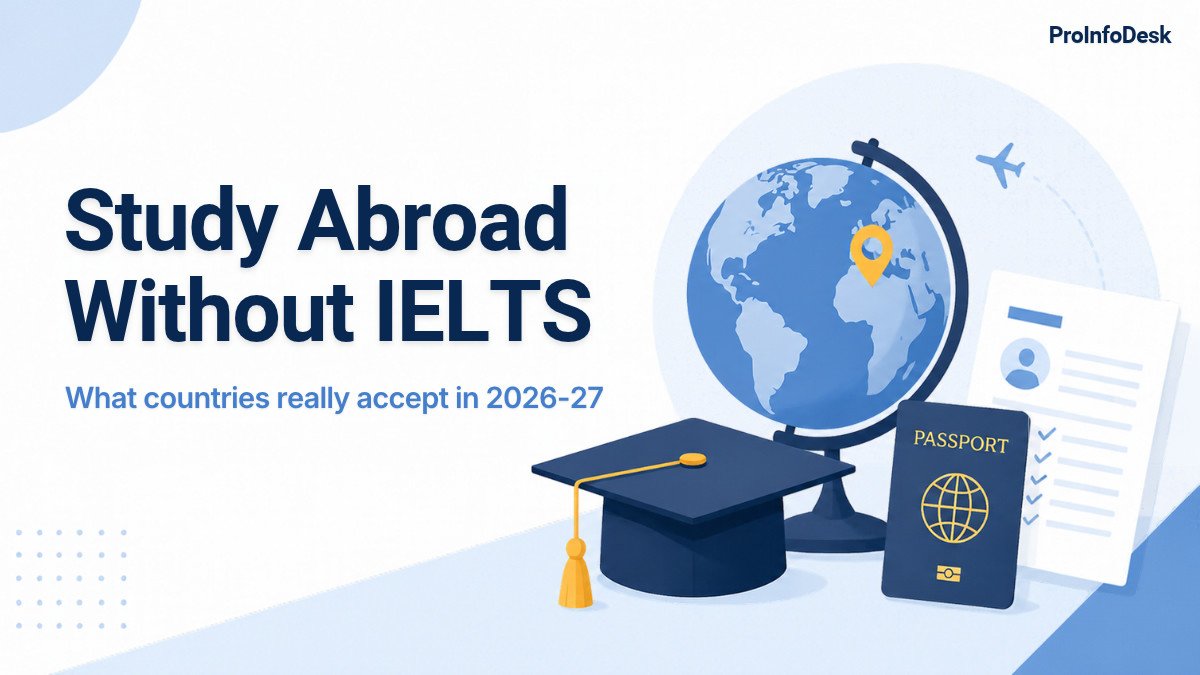
“Study abroad without IELTS” is one of the most searched study-abroad phrases, especially in South Asia and Africa. The honest answer: you can often skip IELTS, but you almost always still need to prove your English somehow. That might be a different test, a letter saying your previous degree was taught in English, or the university’s own interview.
This guide explains what really counts in each major destination for 2026–27 intakes, where the visa rules are stricter than the university’s, and the mistakes that get applications rejected.
The 4 main ways to apply without IELTS
- Another English test: TOEFL iBT, PTE Academic, Duolingo English Test (DET), Cambridge C1 Advanced/C2 Proficiency, LanguageCert or the Oxford Test of English.
- Medium of Instruction (MOI) letter: an official letter from your previous university confirming your degree was taught and examined in English.
- Nationality or country exemption: some universities exempt citizens of majority English-speaking countries, or degrees completed in listed countries.
- University test or interview: some universities assess you themselves, online or on arrival.
Which of these works depends on both the university and the country’s visa rules.
Country-by-country: what’s really accepted
United Kingdom
The UK is one of the most flexible destinations for degree-level study.
- Bachelor’s, master’s and PhD: a university with a good compliance record can choose its own way to check your English, as long as you reach CEFR B2 level. That is why many UK universities accept Duolingo or an MOI letter.
- Below degree level (foundation, pre-sessional and similar courses): you need a Home Office-approved Secure English Language Test (SELT), such as IELTS for UKVI, PTE Academic UKVI or LanguageCert SELT. Duolingo is not a SELT.
Examples:
- University of York (postgraduate taught) accepts Duolingo, PTE, TOEFL, LanguageCert and the Oxford Test of English, and can exempt applicants whose recent degree was taught in English, with official MOI confirmation.
- Cardiff Metropolitan University accepts some school results (for example, CBSE/ISC Class XII English at 60%, or WAEC/NECO C6) in place of IELTS 6.0, and has MOI routes for some postgraduate applicants, including from Pakistan, Bangladesh and Sri Lanka, with an English interview.
- University of Plymouth accepts Duolingo for degree-level courses (105 overall for undergraduate, 120 for postgraduate, with minimum subscores).
Canada
The study permit itself does not require an English test. Since the Student Direct Stream (SDS) ended on 8 November 2024, everyone applies through the regular stream, and IRCC’s document list has no language test. Your university decides.
- University of Toronto (graduate) can exempt you if your degree was from a recognised institution where teaching and exams were entirely in English.
- UBC (graduate) only asks for a test if your previous university’s main language of teaching was not English, and accepts Duolingo for 2027 intakes.
United States
US student visa (F-1) rules leave English requirements to the university. Many US universities accept Duolingo, and several offer MOI waivers. For example, Arizona State University (graduate) accepts DET 105 and offers a waiver if your degree was from an institution where English is the only language of instruction. Expect your visa interview to be in English.
Germany
Germany is popular because public universities charge little or no tuition in most states, but English rules vary a lot between universities.
- Accepts English-taught degrees: the University of Freiburg accepts an English-taught bachelor’s degree as proof at B1/B2 level, and TUM accepts credits earned in English-taught modules where the programme rules allow it.
- Rejects MOI letters: the University of Göttingen and the University of Bamberg say an MOI certificate is not enough proof.
Visa tip: German missions may ask for proof of English unless your admission letter clearly confirms your English is sufficient. If you are admitted on MOI, ask the university to state that in the letter.
Note on fees: Baden-Württemberg charges non-EU students €1,500 per semester, and TUM charges international students tuition. Our Germany Opportunity Card guide covers the work route.
Italy
Politecnico di Milano lets master’s applicants upload a certified document showing their bachelor’s was taught in English instead of a test certificate. But Politecnico warns that Italian embassies may still ask for IELTS or TOEFL for visa purposes, so check with the embassy in your country.
Hungary
The University of Pécs exempts applicants whose previous degree was in English (with some exceptions) and some faculties run their own English test or interview. The University of Debrecen uses its own entrance exam and interview for non-medical programmes. The Stipendium Hungaricum scholarship also accepts proof that your previous studies were in the programme’s language.
Malaysia and China
- Universiti Malaya (postgraduate) exempts applicants whose qualification is from an institution that teaches fully in English.
- Zhejiang University (international graduate programmes) accepts a certificate of instruction in English instead of a test, and also lists alternatives such as GRE scores and, for Pakistani applicants, NTS GAT.
- Not every Chinese university does this: Tsinghua asks non-native speakers for TOEFL or IELTS.
Turkey
Bilkent University accepts IELTS or TOEFL, or you can take its own English proficiency exam on arrival. If you don’t pass, you join its English preparatory programme first.
Where “without IELTS” is harder
Australia
Australia’s student visa (subclass 500) generally needs a score from an approved test unless you are exempt. You can use PTE Academic, TOEFL iBT, LanguageCert Academic, C1 Advanced, CELPIP, MET or OET instead of IELTS, but Duolingo and MOI letters do not count for the visa, and fully online tests are not accepted. Minimum standalone scores include IELTS 6.0, PTE 47 and TOEFL iBT 67.
Netherlands, Finland and Norway
Many universities here only exempt degrees taught in specific English-speaking countries. For example, Wageningen University exempts degrees taught on campus in countries such as the UK, USA, Canada and Australia, and Aalto University in Finland accepts only a short list of tests (no Duolingo). Aalto’s degree exemption list includes India and Nigeria but not Pakistan. Also note that Norway has charged tuition to non-EU students since 2023/24, and Finland charges non-EU students too.
Scholarships: check their rules separately
- Chevening removed its own English requirement in 2020, but you still need an unconditional university offer, so the university’s rule applies.
- DAAD Study Scholarships ask for proof of English through their portal even if the university does not require it. Duolingo is on DAAD’s accepted list, but a university MOI waiver does not automatically satisfy DAAD.
- Erasmus Mundus master’s programmes each set their own language rules.
Browse our list of fully funded scholarships for international students 2027 and the Gates Cambridge Scholarship guide for deadlines.
How to get a strong MOI letter
- Request it from your university’s registrar or controller of exams, on official letterhead, signed and stamped.
- It should say that the whole programme was taught and examined in English, with your name, degree title and years.
- Some universities only accept MOI for degrees completed in the last 5–7 years.
- Upload it with your transcript, and keep the original for your visa appointment.
Mistakes to avoid
- Assuming a “no IELTS” university also means a “no test” visa. Check the visa rules for your course level.
- Booking Duolingo for a UK foundation course or an Australian visa. It won’t be accepted.
- Relying on agent lists of “IELTS-free universities” without checking the official admissions page for your exact programme.
- Forgetting the scholarship’s own language rules.
FAQ
Which country is easiest to study in without IELTS?
For degree-level study, the UK, Canada and the US are the most flexible, because universities set their own English rules and many accept Duolingo or MOI. Australia is the hardest, because the visa needs an approved test.
Is Duolingo accepted instead of IELTS?
By many UK, US and Canadian universities, yes. It is not a UK SELT, it is not accepted for the Australian student visa, and many European universities don’t list it.
Can I get a student visa with only an MOI letter?
For the UK (degree level), Canada and the US, often yes, if your university accepted it. For Australia, no. For Germany and Italy, make sure your admission letter confirms your English level.
Writing your application? Our motivation letter guide can help.
Sources
- GOV.UK: Student visa knowledge of English
- GOV.UK: Approved SELTs
- IRCC: Study permit documents
- Australian Home Affairs: English language tests
- University of York: English requirements
- University of Freiburg: Language certificates
- University of Göttingen: English proof
- Politecnico di Milano: Requirements
- UBC: English language test
- Aalto University: Language requirements
- DAAD Study Scholarships